

As a builder and designer, hands down one of my favorite, but also one of the most stressful, tasks in home building is picking out the kitchen materials. Cabinetry, countertops, plumbing and lighting fixtures, backsplashes and cabinet hardware must all be selected and work cohesively to evoke the desired effect.
Choosing Kitchen Cabinets
When choosing kitchen finishes, many start with the appliances, but I prefer starting with the cabinets. The cabinets will set the overall vibe of the space. Do we want cabinets that are flat front and modern? Or maybe the cabinets are Shaker or panel style for a more classic feel?
When choosing kitchen cabinets, it is important to know that cabinet doors come in three general styles: partial overlay, full overlay and inset.
Partial Overlay Cabinets
Partial overlay is the most basic cabinet door style. The doors close atop the face frame of the cabinet and leave a gap between cabinets so they can be opened without the need for hardware. This type of cabinet is what you will typically find at your local home center.
Full Overlay Cabinets
The second type is full overlay. Again, the cabinet doors sit atop the cabinet’s face frame, but this time with only a minimal gap between. This gives a more expensive look to the cabinets, particularly when paired with the right cabinet hardware. It works well with Shaker, panel or flush cabinet doors.
Inset Cabinets
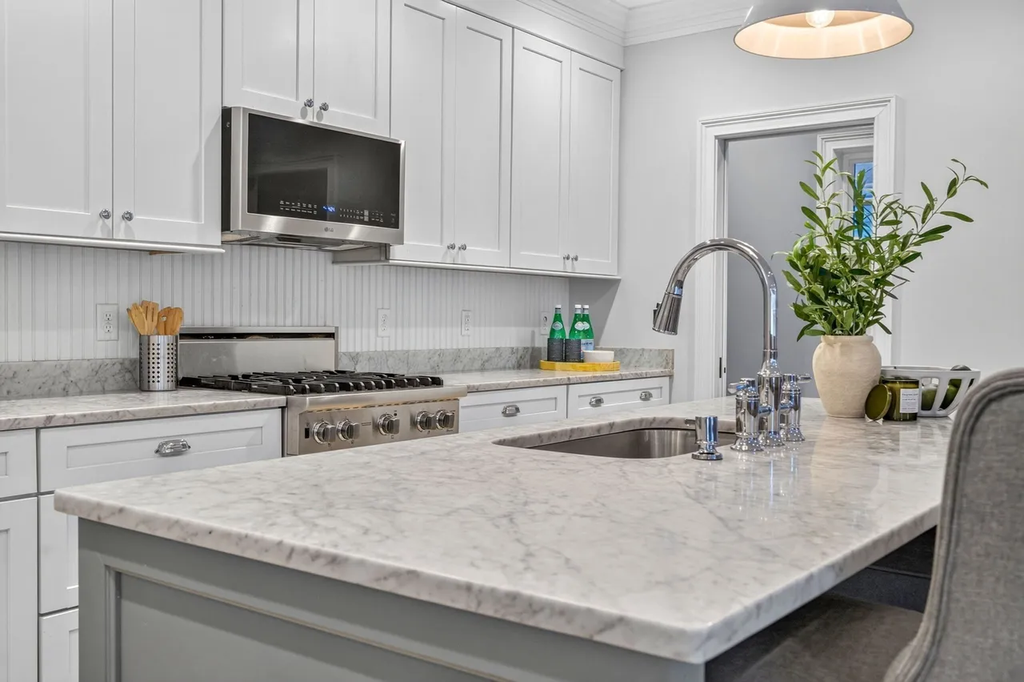
The third style is what we call inset. This is our favorite, and most expensive variation, of course. The cabinet doors in an inset cabinet sit inside the face frames of the cabinet. One of our favorite variations is to take a Shaker cabinet and inset it in a face frame which has a little bead detail around it. Classic!
Selecting Kitchen Appliances
With cabinets picked, most move on to appliances. I usually start with the stove. A standard stove is 30” wide, but variations are also available in 36” all the way up to 60”. A 60” professional range can cost as much as a new compact car, and weigh about the same, so planning is the name of the game. I prefer using a combination range and cooktop, but there are also options for separate cooktops and ovens for the baker in the family.
All stoves, particularly those larger than 30”, should have appropriate ventilation, ideally vented outdoors. Options for range hoods can vary from those built into microwave ovens, to stand-alone over-the-range vents, to custom built-in hoods masked by custom enclosures.
Choosing the Right Refrigerator
Refrigerators generally range from 30” to 60”. The sweet spot for most kitchens will be the 36” refrigerator. We generally choose a “counter-depth” refrigerator. A traditional slide-in refrigerator is deeper than the cabinet opening that it goes in. This makes for a nice spacious refrigerator on the inside, but having the refrigerator stick out can cramp passageways and does not give off custom vibes.
A counter-depth refrigerator is designed to sit closer to the depth of the surrounding cabinetry, although the doors may still project beyond the cabinets. The downside to a counter-depth fridge is that you get less cubic feet of storage space, so some will opt for a second fridge in a pantry, basement or garage so you have a place to put that Costco order.

The other refrigerator option is a built-in version. These can be single units or columns of stainless steel, often with the refrigerator and freezer columns sold separately so that a buyer can get the exact sized fridge and freezer they like. These columns can also be purchased “panel-ready,” meaning that they are ready to receive a cabinet front which matches the other cabinetry for a cohesive look.
Dishwashers and Microwaves
Picking dishwashers for me usually comes down to matching manufacturers. If I have a Café brand fridge and stove, for example, I am inclined to use a Café brand dishwasher. Dishwashers come in a standard 24” width, and most that we use are whisper quiet and have hidden controls. Dishwashers come in a variety of finishes, including stainless steel and panel-ready.
Over-the-range microwaves are popular when using a 30” range, but when using a larger sized range, most will opt for a “drawer” style microwave. These microwaves can go in island cabinets or together with a wall of ovens, for example. Common microwave drawer widths include 24” and 30”.
Additional appliances to consider include a second dishwasher, a built-in coffee maker or a dedicated ice maker.
Choosing Kitchen Countertop Materials
I love picking countertops, but it was not always that way. Plenty of trial and error went into coming up with a countertop equation that works for our projects.
There are a lot of different materials available for kitchen countertops, each with its own appearance, durability and maintenance considerations.
Granite Countertops
Granite is a relatively inexpensive, durable and attractive option. Granite has moved beyond the traditional Uba Tuba or Venetian Gold that are often associated with the granite countertops of the 1990s.
Quartz Countertops
Man-made quartz is another option, but we tend to shy away from it in kitchens. The reasoning is mostly personal preference. I simply prefer a natural stone to a manufactured one for appearance, but that is not to say that quartz does not have its place.
We have used it successfully in kitchens, particularly in large kitchens where oversized slabs were needed. Being man-made, quartz slabs can be manufactured to nearly 12’ in length, with many natural stone slabs measuring approximately 9–10’ in length, although dimensions vary by material and supplier.
We also use quartz in bathrooms regularly as it is highly resistant to water, is easy to clean, and makes a good match with the porcelain and ceramic tiles we often use in baths.
When using quartz, be conscious of the finish. Most quartz countertops have a finish that has a bit of gloss to it. This is not necessarily the look that we want for a kitchen, which tends to look better in less glossy, honed finishes. Quartz manufacturers of late have been introducing new lower-luster variations of quartz to address this concern.
Marble Countertops
Marble is another option. Marble is absolutely beautiful, and there is just something about rolling out dough on a cold white marble counter. The visual is straight out of your favorite cookbook, but that look comes at a cost. Marble is a relatively soft stone, prone to chipping and also prone to water marks and etching.
We have successfully used marble in kitchens by having a special epoxy layer added to the top. This epoxy layer can be sanded and refinished as necessary and is a great solution to the water rings and etching that are commonplace otherwise. The only downsides are that the counters lose that “cool” feel to the touch, and the epoxy can cost as much as the counters.
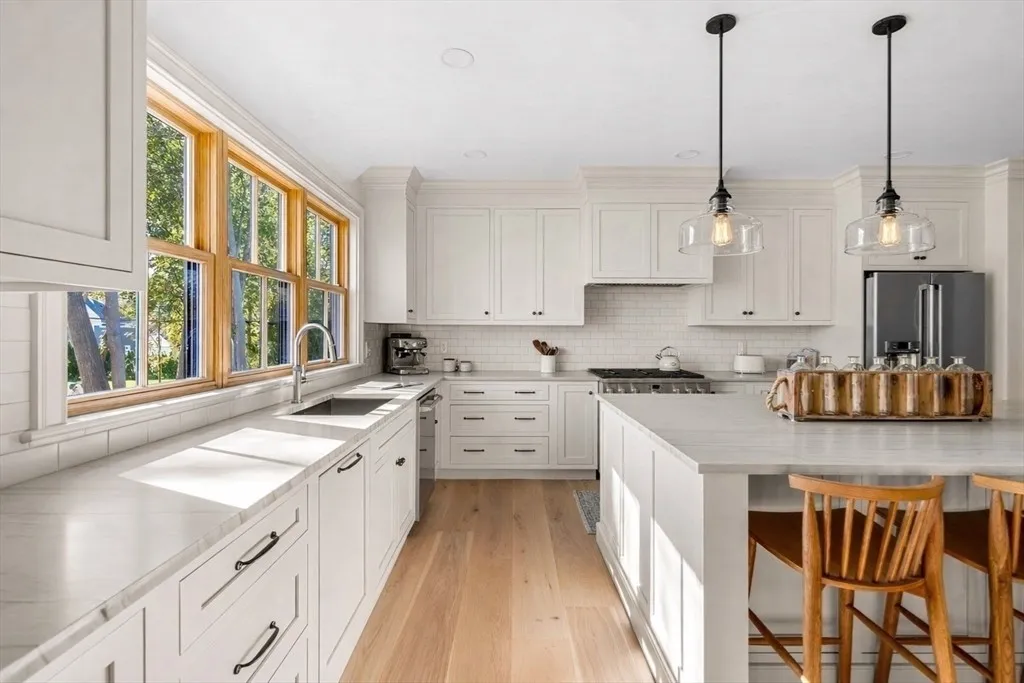
The other marble option we like is called Vermont Danby. Vermont Danby is a beautiful yet durable marble which we love to use as it is local, it has gorgeous veining and it has a low absorption rate, making it less susceptible to stains. You can see it used here, along with a matching backsplash in the image below.
Soapstone Countertops
Another stone option is soapstone, which is a beautiful black and green-leaning stone which changes appearance when wet. This wet look can be maintained by applying mineral oil, an enhancer or a soapstone wax. The stone often has pronounced white or green veining across a black backdrop which is both beautiful and dramatic. The disadvantage to soapstone is that it is very soft and susceptible to scratching and chipping.
Porcelain Countertops
A newer option that has emerged in the last number of years is porcelain. With porcelain, high-resolution graphics can be used to give it the appearance of your favorite porous marble counter, without some of the same maintenance challenges.
Porcelain, however, comes with its own challenges. It is available in a variety of thicknesses, including thin slabs that require specialized fabrication. These thinner sheets must be cut and fabricated to appear as thicker slabs, which adds labor and cost.
Quartzite Countertops
Our favorite countertop choice of late is quartzite. Not to be confused with man-made quartz, quartzite is a naturally occurring stone which is available in a variety of bold and not-so-bold patterns. Quartzite is durable, although its resistance to staining and sealing requirements vary by stone.
It is available in a wide variety of colors from all across the continent. Our favorites include Blue Venato, Taj Mahal and Mustang Quartzite. These slabs tend to come in large sizes with beautiful vein patterns and are often available in honed, polished and leathered finishes.

This is by no means an exhaustive list of the options available, but these are amongst the most popular.
Keep in mind, too, that a slab of Blue Venato Quartzite from one lot might be very different than the same stone from another lot. For that reason, I always recommend physically seeing the slabs before purchasing.
There are stone yards across the area where consumers, designers and builders can go, see slabs in person and “tag” them for delivery. The stone yard sends the slabs to the fabricator. The fabricator in turn comes to the job site, measures for the counters, takes these measurements back to their shop and, using high-tech and very expensive equipment, cuts and routes the slabs into our countertops. The fabricator also handles the installation of the counters.
Choosing the Right Kitchen Sink
One other countertop consideration is the kitchen sink. The countertop fabricator often provides the sink as they are the ones cutting out for it. Most modern sinks are “undermount,” meaning they mount under the counter instead of on top of the counter over the sink cutout.
Otherwise, the choice is in the shape of the bowl. Kitchen sinks can be single bowl or they can have a main bowl and a secondary bowl. They also come in a variety of shapes, from rectangular to “D-bowl” (shaped like a D) to “handmade” with square corners instead of rounded.
Kitchen Plumbing Fixtures, Lighting Fixtures and Cabinet Hardware
The most important plumbing fixture in the kitchen is the faucet. It will get more use than most any other fixture in the house, so don’t cheap out! I prefer using a “bridge” faucet or a single faucet with a pull-down sprayer and often purchase from Kohler or Brizo.
Other kitchen features to consider include a garbage disposal, where appropriate for the home’s plumbing and septic system, a pot filler over your stove or possibly a secondary prep sink and faucet.
Choosing Kitchen Cabinet Hardware
The hardware that you use on the cabinets is one of the most important decisions you will make. We tend to choose hardware that is brass so that it has weight to the touch, and we regularly order knobs and pulls from Restoration Hardware, Top Knobs, Signature Hardware, Rejuvenation and West Elm.
Our favorite hardware colors for kitchens are a soft brass color, matte black hardware or a vibrant polished nickel.
Coordinating Kitchen Lighting and Hardware
We tend to match our light fixtures, such as sconces and island lights, to the hardware, but this is not a hard and fast rule. Mixing metals adds interest when done well.
We also pay attention to the light bulbs. We look up at most kitchen lighting fixtures, think island lights, so sometimes the look of the bulb is as important as the look of the fixture. Using Edison-style bulbs in large round shapes is one of my favorite ways to elevate our lighting.
Kitchen Backsplash Materials and Design
Kitchen backsplashes can make or break your space. As of late, we have been using the same material we use for the counters for the backsplash. This provides a cohesive look, and with some planning, you can even match up the grain pattern from the counters to the backsplash, giving a very tailored and high-end look.
Our other favorite backsplash is the good old subway tile. We use matte finish subway tile from Daltile. They are available in a variety of neutral colors. When using tile, you also have to consider the grout color and the thickness of the grout line. Both will impact the finished look.
Frequently Asked Questions
Planning Your Kitchen Renovation
Selecting kitchen finishes is just one part of planning a successful kitchen renovation. Cabinetry, appliances, countertops and fixtures all need to work together, both in appearance and functionality.
At Cedar Hill Construction Managers, we work with homeowners throughout Gloucester, the North Shore and Metropolitan Boston on custom homes and major renovations. Our approach emphasizes thoughtful planning, collaboration and attention to the details that make a home work for the people living in it.
Before selecting your kitchen finishes, consider reading our guide to Kitchen Layout Design: Planning a Kitchen That Works for Your Home.
You can also learn more about our custom home building services and construction management approach.